LiquidTrust™ is a payments innovation company serving financial institutions, B2B platforms, and SMBs globally.
In our previous article, Finding a Buyer or Supplier Is Only the Beginning of International Trade, we explored why discovering an international opportunity is only the first step.
Before completing a transaction, both businesses still need to verify who they are working with, agree on payment terms, and establish clear expectations.
The first of these is verification.
Why Verification Matters
In many new international business relationships, the buyer and supplier have never worked together before.
The buyer may be preparing to send money to an unfamiliar business. The supplier may be committing inventory, labor, or shipping costs to a customer it has never served.
Verification is not about assuming the other business is dishonest. It is about collecting enough reliable information to make an informed decision before either side commits significant resources.
A business may be legally registered and still present uncertainty. The person communicating with you may not be authorized to represent it, or the payment instructions may not match the verified business.
That is why verification should cover more than whether a company exists. It should connect four important elements: the business, its representative, its payment information, and the specific transaction.
When those details are consistent and independently confirmed, both sides have a stronger basis for deciding whether and how to proceed.
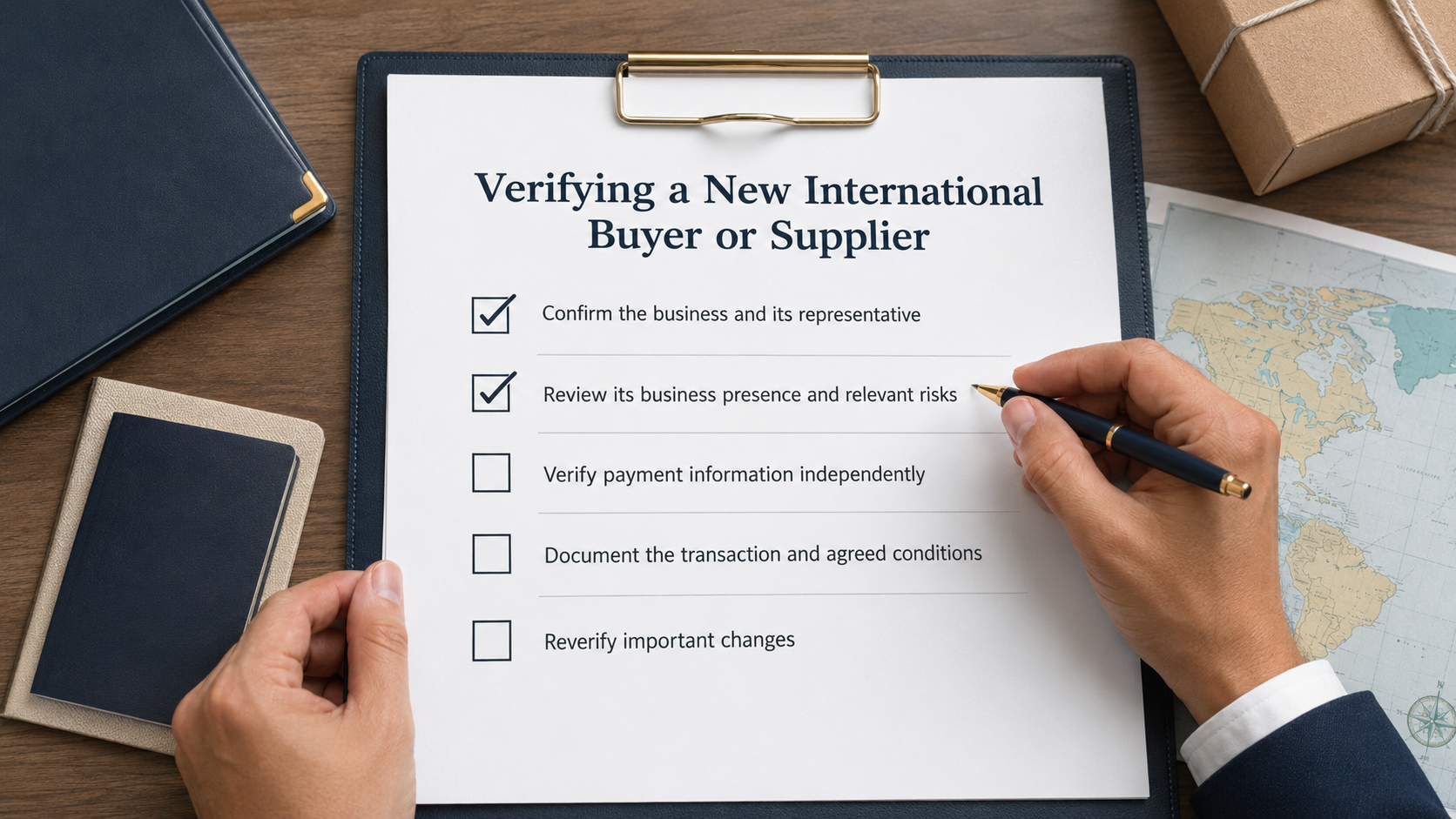
Five Practical Verification Steps
1. Confirm the Business and Its Representative
Start by confirming the company’s legal name, registration status, address, and identifying information through an official business registry or government source.
Depending on the country, this may include a national company register, Secretary of State database, chamber of commerce, tax authority, or trade authority.
Compare the official information with what appears on the company’s website, proposal, contract, and invoice.
Then confirm that the person communicating with you is connected to the business and authorized to discuss the transaction. Review their email domain, role, and contact information using independently confirmed company details.
Registration helps establish that a business exists. Representative verification helps confirm that you are communicating with the right person.
2. Review Its Business Presence and Relevant Risks
Compare the company’s website, contact details, business activity, and public records across reliable sources.
Look for consistency in its:
- Legal and trading names
- Address and phone number
- Products or services
- Industry experience
- Website and email domain
- Required licenses or permits
A limited online presence does not automatically mean a business is illegitimate. Some established SMBs may have simple or outdated websites.
The more important question is whether the available information is consistent with the business and proposed transaction.
Depending on the country, industry, products, and transaction value, additional checks may be appropriate. These could include confirming ownership information, licenses, permits, trade restrictions, or relevant risk indicators.
More complex transactions may require official databases, professional support, or specialized verification services.
3. Verify Payment Information Independently
Payment information should be verified separately before money moves.
Confirm:
- The name of the account beneficiary
- Whether the account belongs to the contracting business
- Whether the account location is consistent with the company’s operations
- Whether the payment details match the information previously provided
- Why a third-party or intermediary account is being used, if applicable
Any new or changed payment instruction should be treated as a reason to pause and verify.
Do not confirm the change by replying to the same email that requested it. Do not rely on a phone number included only in that message.
Instead, contact the business through a previously verified number, its established main line, or another trusted communication channel.
The FBI recommends confirming payment changes and transactions in person or through a known telephone number.
For higher-value transactions, consider requiring a second person to approve new beneficiaries, changed banking information, unexpected payment destinations, or requests to bypass the normal process.
4. Document the Transaction and Agreed Conditions
Verification should connect the business and its representatives to the specific transaction.
Before money or goods move, document:
- The legal names of the buyer and supplier
- The products or services being provided
- The price, currency, and payment schedule
- Delivery requirements and deadlines
- Required documents or evidence
- What happens if the transaction is delayed, changed, or partially completed
- How concerns or disputes will be addressed
The contract, invoice, payment beneficiary, and supporting documents should identify consistent parties.
If the contract names one company, the invoice names another, and payment is requested to an unrelated third party, stop and ask for an explanation.
There may be a legitimate reason, such as a disclosed payment provider, financing arrangement, or affiliated entity. However, the relationship should be explained and verified before the transaction proceeds.
Keep a record of what was reviewed, when it was confirmed, and who approved the transaction. This creates a clear connection between the verified businesses, the payment, and the obligations of the deal.
5. Reverify Important Changes and Start Proportionately
Verification should not be treated as a one-time activity.
Certain changes should trigger additional confirmation, including:
- New banking information
- A different payment beneficiary
- A new email domain or contact person
- A change in the contracting company
- An unexpected shipping destination
- A significant increase in transaction value
- Unusual urgency or pressure to avoid normal controls
Renewed verification does not mean repeating the entire process. It means confirming the information that changed and making sure it remains consistent with the business and transaction previously reviewed.
When practical, begin a new relationship with a smaller order, sample shipment, limited milestone, or staged commitment.
This allows both businesses to establish a working history before moving to larger commitments.
Building Trust Through a Repeatable Process
No verification process can eliminate every risk.
A legally registered buyer may still pay late. A verified supplier may still experience a production delay. A legitimate business may still fail to meet expectations.
Verification has a more practical purpose. It helps an SMB answer three essential questions:
- Is this business real?
- Am I communicating with someone authorized to represent it?
- Do the payment and transaction details match what has been verified?
Verification is more useful when it is consistent and connected to the transaction itself.
A strong process confirms the businesses and people involved, reviews relevant risks, validates payment information, documents what was agreed, and identifies important changes before money or goods move.
Bringing these checks together helps SMBs make informed decisions without relying on scattered searches, documents, and email conversations.
Looking Ahead
Knowing who you are doing business with is the first step toward building transaction confidence.
The next step is deciding how the transaction itself should be structured.
In our next article, we will explore common international payment terms and how SMBs can choose an approach that reflects the transaction, the relationship, and the risks carried by each side.
Payment terms do more than determine when money changes hands. They establish responsibilities and help buyers and suppliers decide how risk will be shared.
Finding a buyer or supplier creates the opportunity.
Verification creates the foundation for trust.
Clear payment terms help turn that foundation into a transaction both sides can confidently complete.